Best Web-to-Print Software in 2026: Why the Editor and the Shop Are Two Different Jobs
Tessa du Plooy
If you’ve started researching web-to-print software, you’ve probably noticed that most “best of” lists compare a strange mix of tools: full storefront platforms, print MIS systems, and design editors, all lined up as if they solve the same problem. They don’t.
Before comparing features, it’s worth asking a more useful question: do you need a shop? or do you need a way to let customers personalize products? one that works inside the shop you already have (or want)?
Two very different categories, one confusing market
Most web-to-print platforms on the market, are built as all-in-one storefronts. They bundle a customer-facing shop, order management, production workflow, and a design tool into a single closed system. That’s a reasonable approach if you’re a print shop building your first online presence from zero and want one vendor to own the whole stack.
The trade-off is lock-in. Your storefront, your checkout, your customer accounts, and your design experience all live inside one vendor’s ecosystem. If you already run Shopify, WooCommerce, Magento, Shopware, or a custom B2B portal or if you simply don’t want your commerce layer dictated by your print software vendor, that bundling becomes a constraint rather than a convenience.
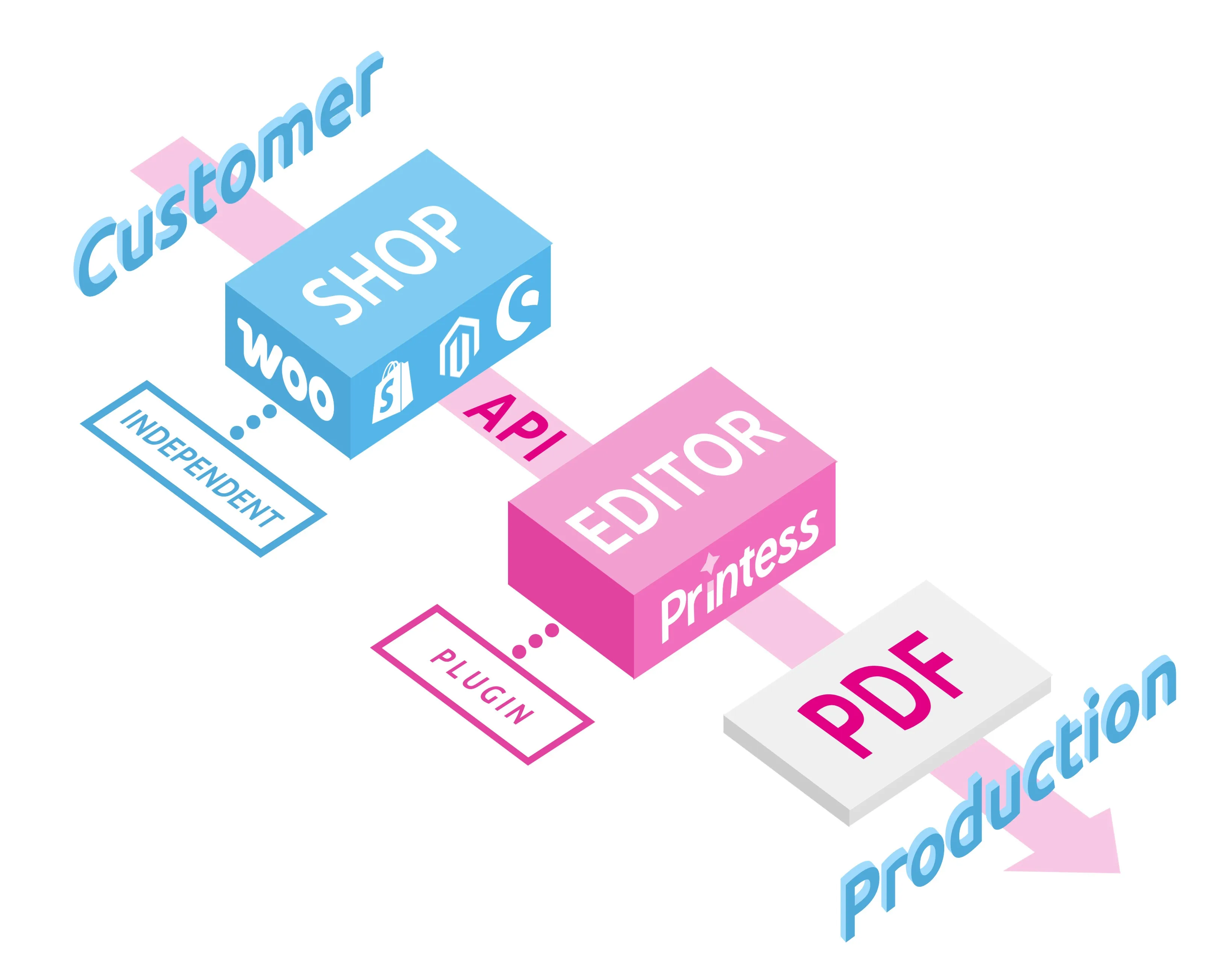
The second category is smaller: personalization editors, sometimes delivered as an SDK (software development kit), that plug into whatever commerce platform you already have. There are few platforms offering this type of model, offering a self-hosted, embeddable design tool. In fact, Printess sits in this category too, but with an important distinction in how it approaches the “shop-agnostic” idea.
Why Printess treats the editor and the shop as separate problems
Printess is a personalization and product-configuration engine, not a shop. It doesn’t ask you to migrate your storefront, retrain your team on a new order-management system, or rebuild the customer accounts and checkout flow you’ve already invested in. It sits on top of the commerce platform you choose; Shopify, WooCommerce, Magento, Shopware, or a bespoke B2B portal. It handles the part that’s genuinely hard to build well: real-time, print-ready personalization. That separation matters for a few concrete reasons:
-
You're not betting your commerce strategy on your print vendor. All-in-one platforms are, understandably, optimized around their own storefront. If your growth plans involve a different ecommerce stack, a multi-brand setup, or a B2B portal your agency partners manage independently, a bundled storefront becomes something you have to work around rather than with.
-
Agencies and B2B print portals need to plug into client systems, not replace them. For agencies managing personalization across multiple client sites, or B2B print providers serving corporate customers with their own procurement systems, an all-in-one shop is often the wrong shape entirely. A shop-agnostic editor integrates into what's already there.
-
Production-ready output shouldn't depend on your shop choice. Whether an order comes from Shopify or a custom-built portal, the same personalization engine generates the same print-ready file, so there is no duplicated design logic across storefronts, no inconsistent output between channels.
-
Switching commerce platforms doesn't mean rebuilding your personalization layer. Storefront platforms get replaced far more often than personalization workflows do. Decoupling the two means a commerce migration doesn't force a parallel rebuild of every product template and design rule.
What to actually evaluate when comparing platforms
Given how different these two categories are, a fair comparison needs different questions depending on what you’re actually buying. If you’re evaluating an all-in-one storefront, the relevant questions are about the whole business: order management, production workflow automation, MIS/ERP integrations, and how much of your existing commerce setup you’re willing to replace.
If you’re evaluating a personalization editor, the questions are different:
-
Does it integrate with the commerce platform you're already using, or the one you actually want?
-
Can non-technical merchandisers manage templates and product rules without developer involvement for every change?
-
Is output genuinely production-ready? Ie. accurate bleed, color, and imposition, or does it need manual cleanup before it reaches the press?
-
Does one integration serve every storefront and B2B portal you run, or does each new sales channel mean rebuilding personalization from scratch?
-
How well does it handle complex product types? Photo products, apparel, packaging, promotional items, without needing a different tool for each?
The shop-agnostic case, in short
The real question isn’t “which platform has the most features.” It’s whether you want your print personalization tied to one vendor’s storefront, or free to sit on top of whichever commerce platform serves your business best — today and after your next migration. For web-to-print sellers, marketing agencies managing multiple client storefronts, and B2B print portals that need to plug into existing procurement systems, that flexibility is essential. It’s the difference between a personalization layer that grows with the business and one that must be ripped out the moment the business outgrows its shop.
Ready to make the shift to Printess?
Check Out Our Live Samples
We have added some really cool features to our Printess editor, take a look at our examples page to get inspiration for your next product release.